Professional cake stacking is more about engineering than art. Learn how experts level, torte, and support tall cakes to ensure they stay perfectly straight and stable.
There is a certain thrill that comes with seeing a towering, multi-layered cake standing perfectly straight on a dessert table. For many home bakers, however, the process of achieving that height without the structure leaning or collapsing feels like a magic trick. The secret does not lie in a special recipe or a specific type of oven, but rather in the meticulous preparation of each individual layer before they ever touch a palette knife. Professional bakers approach the construction of a tall cake as an engineering project, ensuring that every foundation is flat and every support is calculated to hold the weight above it.
Understanding the Anatomy of a Sponge
Before a baker can even think about stacking, they must understand the behaviour of the cake itself. Most sponges naturally dome in the centre during the baking process because the edges of the tin heat up faster than the middle. If you try to stack these domed cakes as they are, you create a curved surface that will eventually cause the top layers to slide off. Professionals often chill their cakes thoroughly before starting the levelling process. A cold cake is much firmer and less prone to crumbling, allowing for cleaner cuts and more precise measurements. This stability is the first step in ensuring a professional finish.
The Art of Levelling the Surface
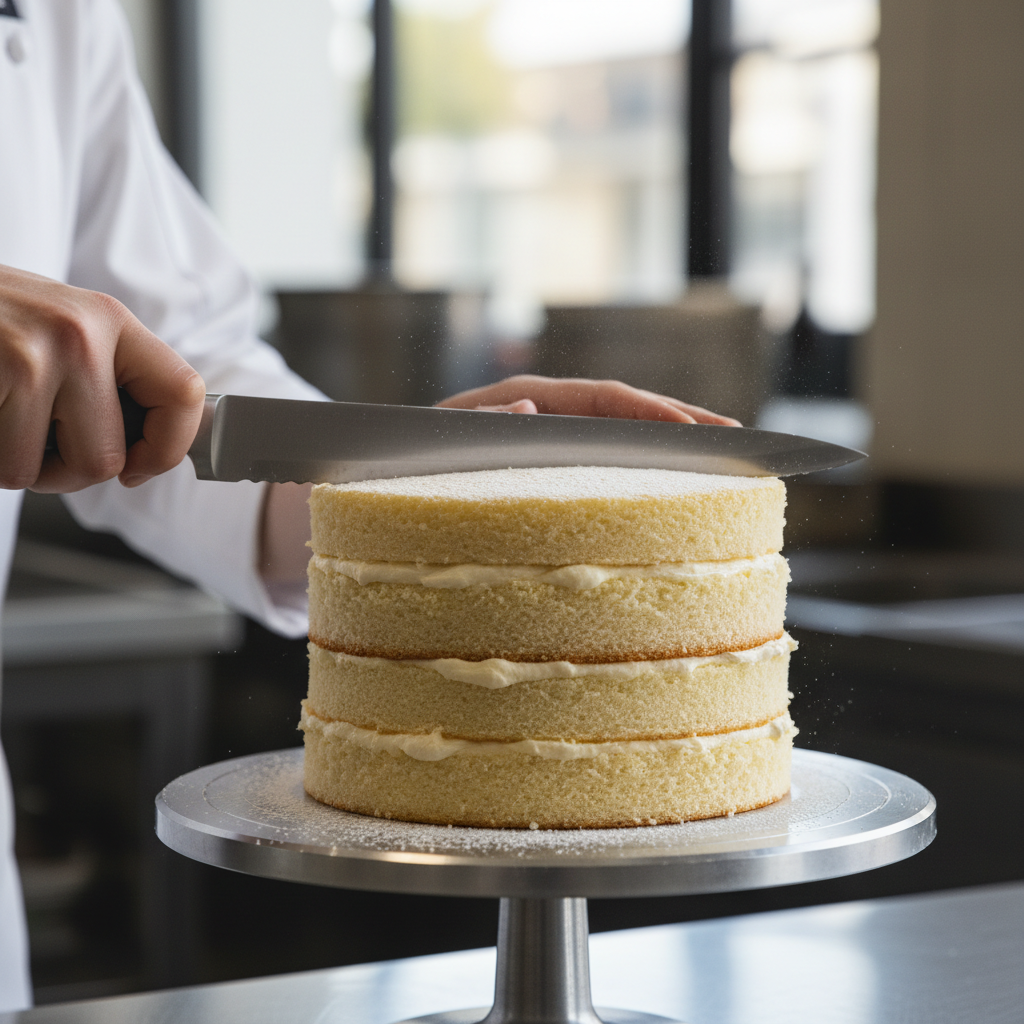
Levelling is the process of removing the rounded top of the cake to create a perfectly flat plane. While it may seem painful to cut away a portion of your hard work, it is non-negotiable for a tall cake. Most experts use a large serrated bread knife or a wire cake leveller. The goal is to remove as little cake as possible while achieving a surface that is parallel to the bottom. To do this manually, a baker will often place the cake on a turntable and slowly rotate it while keeping the knife perfectly horizontal. By making a shallow initial cut around the perimeter and then working toward the centre, you ensure that the blade does not dip or rise.
Splitting Layers for Consistency
Tall cakes are rarely made of two thick slabs of sponge. Instead, professionals often bake two deep cakes and split each one into two or even three thinner layers. This technique, known as torting, allows for more layers of filling, which adds moisture and flavour. Consistency is key here. If one layer is thicker on the left than the right, the entire cake will begin to tilt as you add height. Using a ruler to mark the halfway point around the cake before cutting helps maintain an even thickness across every slice. At WaraCake, we find that these thinner, multiple layers create a better structural integrity than trying to balance two very heavy, thick sponges.
The Importance of the Crumb Coat
Once the layers are level and split, the assembly begins. A crucial step that many beginners skip is the crumb coat. This is a very thin layer of icing applied to the entire exterior of the assembled cake. Its primary purpose is to trap loose crumbs, but in a tall cake, it also acts as a primer that seals the gaps between layers. This thin coat must be refrigerated until it is firm to the touch. This creates a solid shell that holds the internal structure together, preventing the weight of the outer frosting from causing the cake to bulge or shift during the final decoration.
Internal Supports and Dowels
When a cake reaches a certain height, the weight of the upper sections can actually crush the lower layers of sponge. To prevent this, professional bakers use internal supports such as wooden dowels, plastic straws, or specialised cake pillars. These supports are cut to the exact height of the bottom section and inserted vertically. A thin cake board is then placed on top of these dowels before the next tier or section is added. This ensures that the weight of the top half is resting on the dowels and the floor of the cake board rather than on the soft sponge below. Without these hidden pillars, even the most level cake will eventually succumb to gravity.
Centering and Alignment
Achieving a perfectly vertical cake requires constant checking from different angles. Professional bakers often use a small spirit level, the same tool a builder might use, to ensure the top of the cake is flat. As each layer is added, it is vital to look at the cake from a distance and at eye level. If a layer is slightly off-centre, it must be adjusted immediately before the frosting sets. Some bakers use a central dowel, which is a long rod driven through the very centre of all the tiers from top to bottom. This prevents the layers from sliding horizontally during transport.
Final Smoothing for a Polished Look
The final stage of stacking a tall cake is the finishing coat of buttercream or ganache. Because the cake is already level and supported, this part becomes much easier. Using a tall metal bench scraper and a turntable, the baker applies a generous amount of frosting and then scrapes it away to reveal a smooth, straight edge. Because the internal structure is sound, the baker can apply pressure with the scraper without worrying about the cake wobbling. This creates that sharp, clean silhouette that defines a professional high-tier cake. At WaraCake, we understand that this precision is what transforms a simple dessert into a centrepiece.
If you are planning a celebration and want a beautifully structured cake without the stress of levelling and dowelling it yourself, we would be delighted to help. You can explore our collection of professionally crafted designs and have your perfect cake delivered to your door.